
Sikkim
Tucked away in the northeastern Himalayas, Sikkim is India’s hidden crown jewel. It’s not just a place you visit; it’s a place you feel. From dramatic mountain peaks to deep-rooted spiritual tranquility, Sikkim offers an escape that feels entirely detached from the chaos of everyday life.
Why Visit Sikkim?
1. The Majesty of Khangchendzonga
Sikkim is home to Mount Khangchendzonga ($8,586 \text{ m}$), the third-highest peak in the world. The mountain isn’t just a geographic landmark; it’s revered by the locals as a guardian deity. Whether you are catching the sunrise from Tiger Hill or trekking through the Khangchendzonga National Park (a UNESCO World Heritage Site), the views of these snow-capped peaks are nothing short of life-changing.
2. A Pioneer in Eco-Tourism and Organic Living
If you want to see what the future of sustainable travel looks like, Sikkim is leading the way.
• 100% Organic: In 2016, Sikkim became the world’s first fully organic state. Every meal you eat here—from local wild ferns to fresh mountain apples—is completely free of chemical pesticides.
• Plastic-Free & Clean: Sikkim is fiercely protective of its environment. Single-use plastics are banned, and towns like Ravangla and Namchi are famously pristine.
3. Surreal Landscapes (The Switzerland of the East)
The sheer diversity of landscapes packed into this tiny state is mind-boggling. You can experience multiple microclimates in a single day:
• Yumthang Valley: Known as the “Valley of Flowers,” which bursts into a riot of rhododendrons and primulas during spring.
• Gurudongmar Lake: Situated at an altitude of $5,430 \text{ m}$ ($17,800 \text{ ft}$), it is one of the highest lakes in the world, featuring breathtaking, crystal-clear blue waters surrounded by snow-covered peaks.
• Nathu La Pass: The ancient Silk Route border trading post between India and Tibet, offering dramatic, rugged high-altitude vistas.
4. Spiritual Sanctuary and Monastic Culture
If you are looking to disconnect and find some inner peace, Sikkim’s spiritual vibe is unmatched. The air here is filled with the flutter of prayer flags and the sound of distant chants.
• You can explore ancient Tibetan Buddhist monasteries like Rumtek, Pemayangtse, and Enchey.
• Visit the towering Tathagata Tsal (Buddha Park) in Ravangla, where a $130\text{-foot}$ bronze Buddha statue sits framed beautifully against the Himalayan range.
5. Thrills for the Adventurer
Sikkim is an outdoor playground for adrenaline junkies. Depending on your thrill level, you can dive into:
• Trekking: The legendary Goechala Trek gets you close enough to touch Khangchendzonga.
• White Water Rafting: Battle the ferocious rapids of the Teesta and Rangeet rivers.
• Paragliding: Glide over the capital city of Gangtok with the Himalayas as your backdrop.
Best Time to Visit
1. The Spring Peak: March to May (Best for Flowers & Greenery)
If you want to see Sikkim at its most vibrant, this is the time to go. The winter snow begins to melt, and the valleys burst into color.
- The Vibe: Mild, pleasant days and crisp, cool nights. Temperatures range comfortably between 5°C and 25°C.
- Why visit now: This is peak season for nature lovers. The Yumthang Valley and Shingba Rhododendron Sanctuary come alive with over 24 varieties of rhododendrons and orchids in full bloom (usually peaking between late April and May).
- Ideal for: General sightseeing, high-altitude lake visits (Tsomgo, Gurudongmar), and low-to-mid altitude trekking.
2. The Autumn Peak: October to November (Best for Clear Mountain Views)
Once the monsoon clouds clear out, autumn offers the sharpest, most breathtaking views of Mount Khangchendzonga and the surrounding Himalayan range.
- The Vibe: Fresh, crisp, and clean air. The weather is cool, with temperatures hovering between 10°C and 20°C in the day, dropping rapidly at night.
- Why visit now: If photography or seeing the big peaks is your primary goal, this window is unmatched. The skies are a brilliant, deep blue, and the atmosphere is incredibly clear. This is also a festive time, where you can catch local celebrations like Dashain and Tihar.
- Ideal for: High-altitude trekking (like the Goechala Trek), paragliding, and uninterrupted landscape photography.
3. The Winter Wonderland: December to February (Best for Snow Lovers)
Winter transforms Sikkim—especially North and West Sikkim—into a dramatic, silent, snow-covered paradise.
- The Vibe: Cold to freezing. Temperatures in Gangtok hover around 4°C to 12°C, but drop well below zero ($0^\circ\text{C}$) in higher regions like Lachen, Lachung, and Pelling.
- Why visit now: You have a very high chance of experiencing fresh snowfall. It’s also the time for the vibrant Losar Festival (Tibetan New Year) and cultural mask dances at the monasteries. Bonus: Fewer tourists mean lower hotel rates and peaceful viewpoints.
- The Catch: Heavy snowfall frequently blocks the roads to high-altitude spots like Nathu La Pass and Gurudongmar Lake. If you choose winter, you must keep your itinerary flexible.
How to Reach Sikkim
1.By Air
Option A: Bagdogra International Airport (IXB)
Located in West Bengal, Bagdogra is the main gateway to Sikkim. It connects to all major Indian cities (Delhi, Mumbai, Kolkata, Bengaluru) with frequent daily flights.
- Distance to Gangtok: approx 125 {km}
- Travel time: 4.5 to 5.5 hours by taxi.
- Pro-Tip: From Bagdogra, you can also book a seat on the Sikkim Helicopter Service, which flies from Bagdogra to Gangtok in just 20 minutes (subject to weather conditions and availability).
Option B: Pakyong Airport (PYG)
Pakyong is Sikkim’s first and only airport, located right inside the state.
- Distance to Gangtok: approx 30{km}
- Travel time: 1 to 1.5 hours by taxi.
- The Catch: Because it is a high-altitude table-top airport, flights (mostly from Kolkata or Delhi) are heavily dependent on low visibility and weather conditions. Cancellations are common, so Bagdogra remains the safer bet.
2. By Train
Sikkim does not currently have active commercial passenger railway tracks (though a massive rail project connecting Sevoke to Rangpo is under construction). The nearest major railway stations are in neighboring West Bengal:
- New Jalpaiguri (NJP) Railway Station: This is the most popular railhead. It is extremely well-connected to the rest of India, with regular superfast trains and Rajdhanis arriving from Delhi, Kolkata, and Guwahati.
- Distance to Gangtok: 120 {km}
- Travel time: 4.5 to 5 hours by taxi.
- Siliguri Junction: Another nearby station, mostly handling regional trains.
3. By Road
Whether you land at Bagdogra or arrive at NJP, you will ultimately need to take the road to enter Sikkim. The drive takes you along the gorgeous, winding Teesta River via National Highway 10 (NH10).
Top Places to Visit in Sikkim
East Sikkim: The Cultural & Gateway Hub
Gangtok
The capital city is a beautiful blend of traditional northeastern culture and modern, clean urban living. It is completely pedestrian-friendly and free of litter.
- Top Highlights: Take a cable car ride over the city, walk down the bustling MG Marg, and visit the Enchey Monastery.
- Don’t Miss: The Do Drul Chorten stupa and the nearby Namgyal Institute of Tibetology to see rare Buddhist artifacts and manuscripts.
Tsomgo Lake & Nathu La Pass
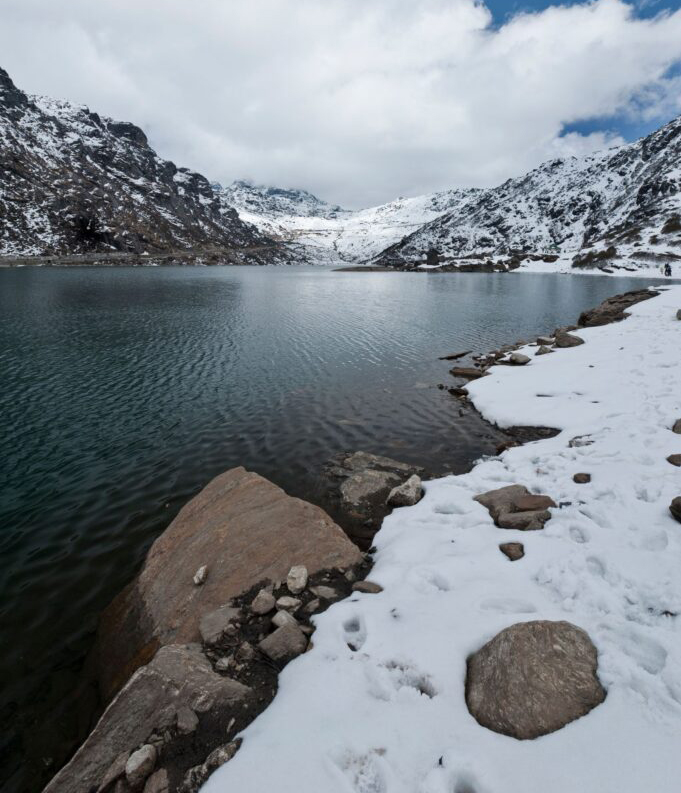
Located about $40 \text{ km}$ from Gangtok at an altitude of $3,753 \text{ m}$ ($12,313 \text{ ft}$), Tsomgo (Changu) Lake is a glacial water body that changes color with the seasons—from deep turquoise in summer to completely frozen solid in winter.
- The Extra Mile: Drive further up to Nathu La Pass, the heavily guarded Indo-China border along the ancient Silk Route. (Note: Requires a special permit).
North Sikkim: High-Altitude Drama
Yumthang Valley & Lachung
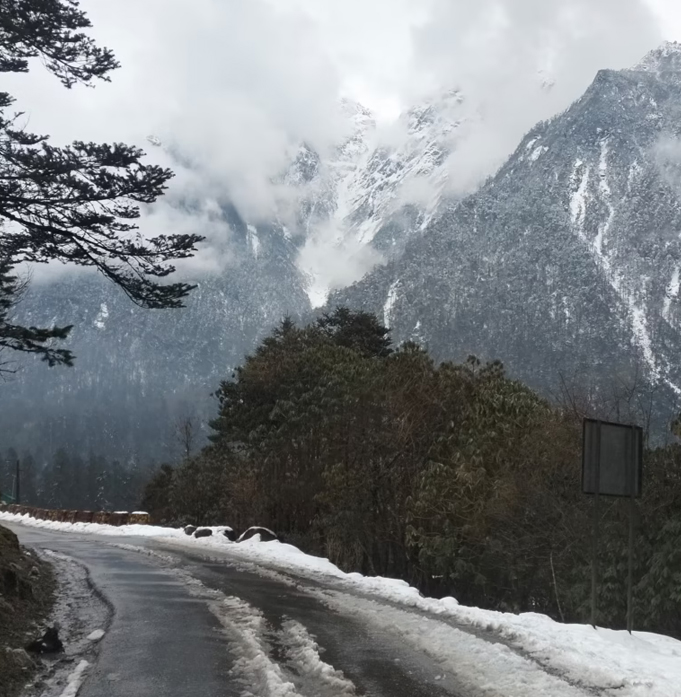
Often called the “Valley of Flowers of the East,” Yumthang is a surreal alpine meadow surrounded by snow-capped peaks, pine forests, and hot springs.
- When to go: Visit in spring (April–May) to see the entire valley carpeted in thousands of blooming rhododendrons.
- The Base Camp: You will stay overnight in Lachung, a gorgeous, quiet mountain village split by a rushing river.
Gurudongmar Lake & Lachen
For the true adventurer, this is the holy grail of Sikkim. Sitting at a staggering 5,430{m}(17,800 { ft}), Gurudongmar is one of the highest lakes in the world. Its deep blue waters remain partially unfrozen even in the dead of winter, a phenomenon locals attribute to a blessing by Guru Padmasambhava.
- The Base Camp: You’ll stay the night in Lachen and drive up before dawn to beat the high-altitude winds.
West Sikkim: Heritage and Epic Views
Pelling
If your main goal is to wake up to uninterrupted, panoramic views of Mount Khangchendzonga right outside your hotel window, Pelling is where you go.
- Top Highlights: Walk across the thrilling Pelling Skywalk (India’s first glass skywalk) which leads to a massive statue of Chenrezig.
- History Buffs: Explore the atmospheric ruins of Rabdentse, which was the second capital of the former Kingdom of Sikkim from 1670 to 1814.
4. South Sikkim: Spiritual Architecture
Ravangla (Buddha Park)
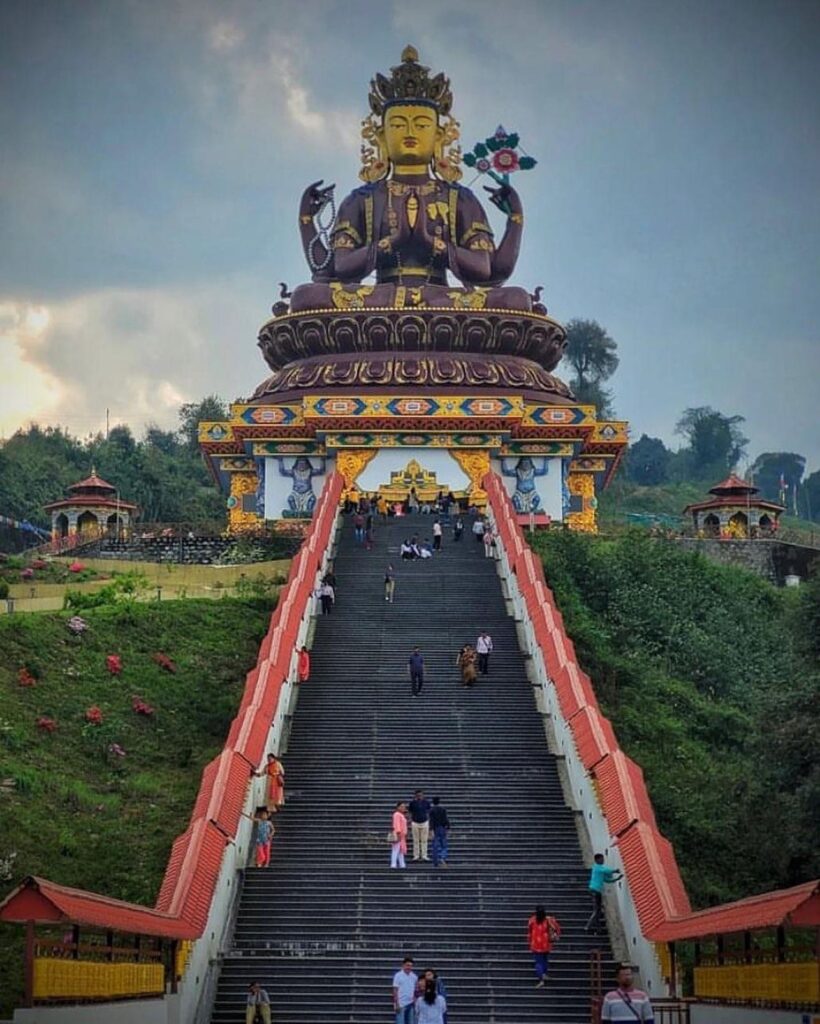
Ravangla is home to Tathagata Tsal, famously known as the Buddha Park. It features a magnificent, 130{foot} tall bronze statue of Buddha sitting majestically against a backdrop of open skies and rolling green mountains. The eco-garden around it is incredibly peaceful and beautifully manicured.
Namchi (Siddheshwar Dham)
Namchi is the cultural and religious capital of South Sikkim. Its crowning jewel is Char Dham (Siddheshwar Dham), a massive pilgrimage complex featuring a $108\text{-foot}$ statue of Lord Shiva surrounded by replicas of India’s four most sacred Hindu temples.
Important Notes
Sikkim shares international borders with Bhutan, Tibet (China), and Nepal.
Foreign Nationals
One must obtain a Restricted Area Permit (RAP) / Inner Line Permit (ILP) to enter Sikkim. This is free and can be obtained at the border check posts (like Rangpo or Melli) upon showing your passport and Indian Visa.
Indian Citizens
Don’t need a permit to enter Gangtok, but you will need daily permits to visit protected areas like North Sikkim (Lachen/Lachung), Nathu La Pass, or Tsomgo Lake. Keep at least 4–5 passport-sized photos and copies of your ID (Aadhar/Voter ID) handy.